Apartment Cooking Without Setting Off Smoke Alarms
The smoke alarm in an apartment is sensitive on purpose. With a few small habits, you can cook seriously without setting it off.


This article is about how to cook with heat, flavor, and intent in a small apartment without becoming the resident known for tripping the building’s alarm system. The fixes are simple. The payoff is years of real food in a small kitchen.
Why apartment smoke alarms are so sensitive
Apartment smoke alarms are usually mounted close to the kitchen and tuned to be sensitive because kitchen fires are common in small units. Their sensitivity is a feature, not a flaw. The problem is that this sensitivity also triggers on cooking smoke that does not represent a real fire.
The alarms are usually photoelectric (detecting smoke particles in the air) or ionization-based (detecting changes in air composition), the two types the NFPA covers in its guidance on home smoke alarms. Both will trip when meaningful smoke or vapor enters their chamber. Reducing the amount of smoke that reaches them is mostly mechanical.
You cannot legally disable the smoke alarm in most apartments. You can, however, reduce the smoke at the source, redirect the smoke away from the alarm, and ventilate effectively. Together, these almost completely eliminate the false-alarm problem.

The exhaust fan, again
The single biggest factor in apartment cooking is your exhaust fan. Most apartments have a small recirculating hood that vents back into the kitchen. These do almost nothing for smoke. Some apartments have a true vented hood that removes smoke from the unit. These work much better.
If you have a true vented hood, turn it on before you start cooking, not when you see smoke. Run it on high during any high-heat cooking. Leave it running for at least ten minutes after you finish.
If you have a recirculating hood, supplement it with a window fan blowing outward and a window open elsewhere in the unit. The two-window setup creates cross-ventilation that pulls smoke out of the kitchen. A box fan in a window, blowing out, does much of what a vented hood would do.
Start the exhaust fan and the window fan before you turn on the burner. Pre-loaded ventilation is much more effective than reactive ventilation. By the time you see smoke, the fan has already been moving air for two minutes.
The smoke point of oils
Most apartment cooking smoke comes from oil that has exceeded its smoke point. Butter smokes at around 350F. Olive oil smokes at around 400F. Vegetable oils smoke higher, around 425 to 450F. Refined oils (avocado, refined canola, peanut) smoke at 450F or above.
For high-heat cooking like searing, switch to a high-smoke-point oil. The difference is dramatic. A pan that smokes furiously with butter will be nearly smoke-free with refined avocado oil at the same temperature.
You can also lower the heat. A medium-high sear at 350F still develops a meaningful crust on most proteins but produces much less smoke than a maximum-heat sear at 500F. The crust may be slightly less dramatic but the meal is still excellent.
The pan matters more than people think
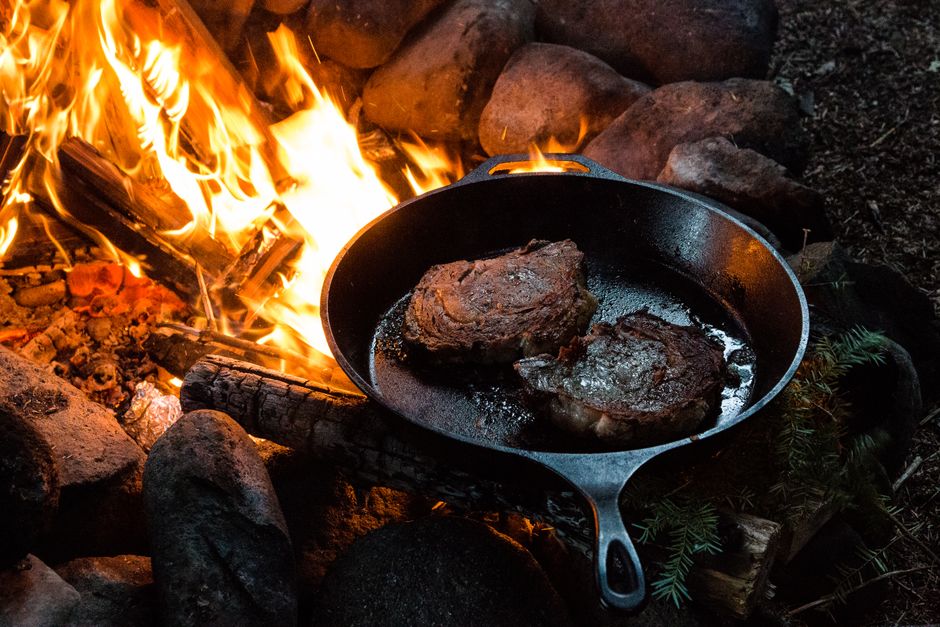
Heavy-bottomed pans (cast iron, carbon steel, thick stainless) hold heat evenly and reduce hot spots that produce sudden smoke. Thin pans heat unevenly, and the hot spots can hit the smoke point of the oil while the rest of the pan is still warming up.
If you are using a thin pan for high-heat cooking, the result is almost always smoke and uneven cooking. A single heavy pan in the kitchen is one of the best apartment cooking investments. Cast iron is the most common choice, but carbon steel is lighter and easier to maneuver in small kitchens.
Techniques that produce less smoke
A few techniques shift you away from smoke-producing patterns:
- Reverse searing. Cook proteins low in the oven first, then sear briefly at high heat. The sear is shorter, so less smoke.
- Sous vide and finish. Bring proteins to temperature in a water bath, then sear briefly. Same idea, even more controlled.
- Roasting in a covered pan. A lid traps smoke before it spreads. Open it under the running exhaust fan.
- Braising. Long, low cooking in liquid produces almost no smoke. A braise is one of the most apartment-friendly techniques in cooking.
- Stir-frying with a screen. Use a splatter screen as a smoke screen. It catches enough particles to reduce alarm triggers significantly.
What to do when the alarm goes off
If the alarm goes off, do not panic. Turn off the heat. Open the door briefly to let smoke escape into the hallway, then close it. Open windows. Run all available fans. Wave a dish towel under the alarm to disperse the smoke directly under the detector. Most alarms reset within thirty seconds once the smoke clears.
If the alarm continues, check the manual reset button. Most have a small button on the bottom or side. Press it firmly. Some buildings have interconnected alarms where one triggering activates all of them. In those cases, you may need to wait for the system to clear.
Avoid the temptation to remove the alarm from the wall or take out the battery. This is a lease violation in most apartments and creates a real safety risk. The alarm exists because cooking fires do happen, and the few seconds of warning matter.
The neighbor consideration
If your alarm triggers regularly, the hallway gets to know. Other residents may hear it. The smell of smoke can travel under your door. Building management may take notice.
Apologize quickly if a triggered alarm causes a fire department response. False alarms cost the building. A short, sincere apology to the building manager goes a long way. Avoid the pattern of repeated triggers without changes to your cooking setup.
If your alarm is genuinely too sensitive (some are), ask building management about replacement. Many buildings will swap a chronically false-triggering alarm for a slightly different model. The request is reasonable and most buildings will take it seriously.
The cooking habits that stick
After a year of cooking in a smaller apartment, the habits that work are remarkably consistent:
- Fan on before heat.
- Window open during cooking.
- High-smoke-point oils for searing.
- Heavy pans for even heat.
- Lid on when you can.
- Run the fan ten minutes after.
None of these change the food. They change the environment around the food. You are still searing, still roasting, still doing the cooking you want to do. The smoke alarm stops triggering. The neighbors stop smelling your meals. Your apartment stops accumulating cooking residue on the walls.
What you build, slowly
The real reward of apartment cooking is the meals themselves. A small kitchen does not stop you from making real food. The renters who feel like their apartments do not let them cook are usually missing two or three of the small mechanical adjustments. Once you have them, the kitchen feels twice as capable. The exhaust fan, the heavier pan, the higher-smoke oil, the cross-ventilation. Small parts that together let you do almost anything serious cooks do in larger kitchens. Without the smoke alarm becoming the soundtrack of your dinner.
Frequently asked
Is it okay to take the battery out of the smoke alarm while cooking?
No. This is a lease violation in most apartments and creates a real safety risk. Use ventilation and lower-smoke techniques instead.
What oil should I use for high-heat cooking?
Refined avocado oil has one of the highest smoke points (520F) and a neutral flavor. Refined peanut, refined canola, and grapeseed are also good options.
How can I tell if my exhaust fan actually vents outside?
Look outside the building for a kitchen exhaust vent. If you cannot see one, the fan is probably recirculating. The building manager can confirm.
Will high-temp cooking damage my pots and pans?
Cast iron and carbon steel handle high temperatures well. Non-stick pans should never be heated above 400F because the coating degrades. Stainless steel is fine at high temperatures.
Related guides
 Apartment Living
Storage in Six Hundred Square Feet, Without the Hacks
Real apartment storage in a small unit is more about culling than clever furniture. A grounded look at what works…
 Apartment Living
Mailroom Habits That Make You a Quiet Favorite
The mailroom is one of the few places where the whole building eventually meets. A few small habits make you…
 Apartment Living
The Realistic Way to Compost in a Small Unit
Composting in an apartment is realistic, clean, and surprisingly low-effort with the right system. A grounded look at the options…